AI business intelligence · Analytics
BI Next
Designed & built full-stack by Farivar Zarvandeh
Ask your business data a question instead of hunting through dashboards.
Which customers cost us the most margin?
…
- Customer A
- Customer B
- Customer C
- Customer D
- Faster like-for-like queries
- 30×
- Invoice lines in the canonical fact
- 113k
- Metrics × dimensions
- 21 × 13
- Reconciliation to ERP
- ≤ 0.44 %
- Sandbox escape tests rejected
- 10 / 10
Figures counted from the repository; maturity note: Built for a B2B wholesale client and running in Docker against their live PostgreSQL database. The data layer, API, assistant with sandbox, controlling, sales and report pages are complete and verified; two analysis pillars are still stubs, and one dimension (target group) uses clearly badged mock data until the ERP mapping exists. Voice input is planned.
01
Product introduction
BI Next replaces a classic dashboard BI with an AI analyst over a PostgreSQL database. Managers ask in plain language; a grounded LLM agent calls read-only tools, writes and runs analysis code in a sandbox in real time, and answers with figures that tie out to the cent with what the screens show.
02
The problem
The client's legacy dashboard BI was slow (2–4 s per page), reported different values for the same KPI on different pages, was organised by database table instead of management question, and explained none of its figures. A business rule applied to only some views inflated revenue by 22 % and contribution margin by 34 %. Its first AI assistant read those wrong numbers from a fixed snapshot and was told never to admit missing data, which invited hallucination.
03
The solution
BI Next rebuilds the data layer in PostgreSQL around one canonical line-level fact and five materialised marts, with every KPI defined once in a metric registry that drives the SQL, labels, tooltips, glossary and exports. On top sits an AI analyst: a tool-calling LLM that queries the same scoped path as every screen, writes pandas code that runs in an isolated sandbox when a question needs a calculation over the whole population, and returns a full trace of every call and result. Classic pages remain for routine controlling, but the main interface is a question.
04
Core features
Grounded analysis assistant
ImplementedA tool-calling LLM (Gemini 2.5 Flash) with read-only tools for KPIs, breakdowns, time series, alerts and the metric registry. Every number must come from a tool result, and the loop is bounded to eight steps.
Live code execution
ImplementedFor counts, Pareto analyses and distributions the model writes pandas code that runs in an isolated subprocess with an AST gate, restricted builtins and a hard 8 s timeout, and the exact result is returned.
Auditable answers
ImplementedEach answer ships with the full trace of tool calls and their real results, so any figure in the prose can be checked.
Honest refusals
ImplementedThe data boundary is stated in the prompt: the assistant refuses questions about order intake, forecasts or stock that invoice data cannot answer, instead of guessing.
Canonical data layer
ImplementedOne line-level materialised fact over the ERP tables and five monthly marts, with indexes and a nightly refresh, leaving the ERP source tables untouched.
Metric registry
Implemented21 metrics across 13 dimensions, each defined once; a KPI cannot be shown without a definition, and the glossary is generated from it.
Management pillars
PartialControlling, sales steering and reports with Excel export organised by management question; the customer-pricing and assortment pillars are still being built.
Sales agent cockpit
ImplementedScoped logins for field agents show their own margin leaks (terms, free goods, returns) per customer, paired with the lever they control.
Audited global data filter
ImplementedAdmins can exclude intercompany or test entities from every report; the effect is previewed in euros, shown on every page and logged.
Voice questions
PlannedSpeaking a question instead of typing it.
05
System architecture
ERP source tables in PostgreSQL stay read-only. A canonical line-level materialised view is the only place business rules are written; five monthly marts aggregate from it. A FastAPI service exposes generic KPI, time-series and breakdown endpoints driven by a metric registry, applies row-level scope and the global filter server-side, and hosts the AI analyst. The analyst calls the same scoped query path as the screens and hands already-scoped rows to an isolated Python sandbox for live calculations. A React SPA renders the pillars, reports and the assistant chat with its tool trace.
Hover or focus a component to trace its real connections.
9 components · 9 connections, as found in the repository.
06
Technology stack
- frontend
- React 19TypeScriptViteTailwind CSS 4React Router 7TanStack QueryRecharts
- backend
- PythonFastAPIpandasNumPy
- data
- PostgreSQLMaterialised viewspg_cron
- ai
- Google Gemini 2.5 FlashFunction callingSandboxed code execution
- infra
- Docker ComposenginxGoogle Cloud SQL
- integrations
- ERP invoice tablesPimcoreExcel (XLSX)
07
Product experience
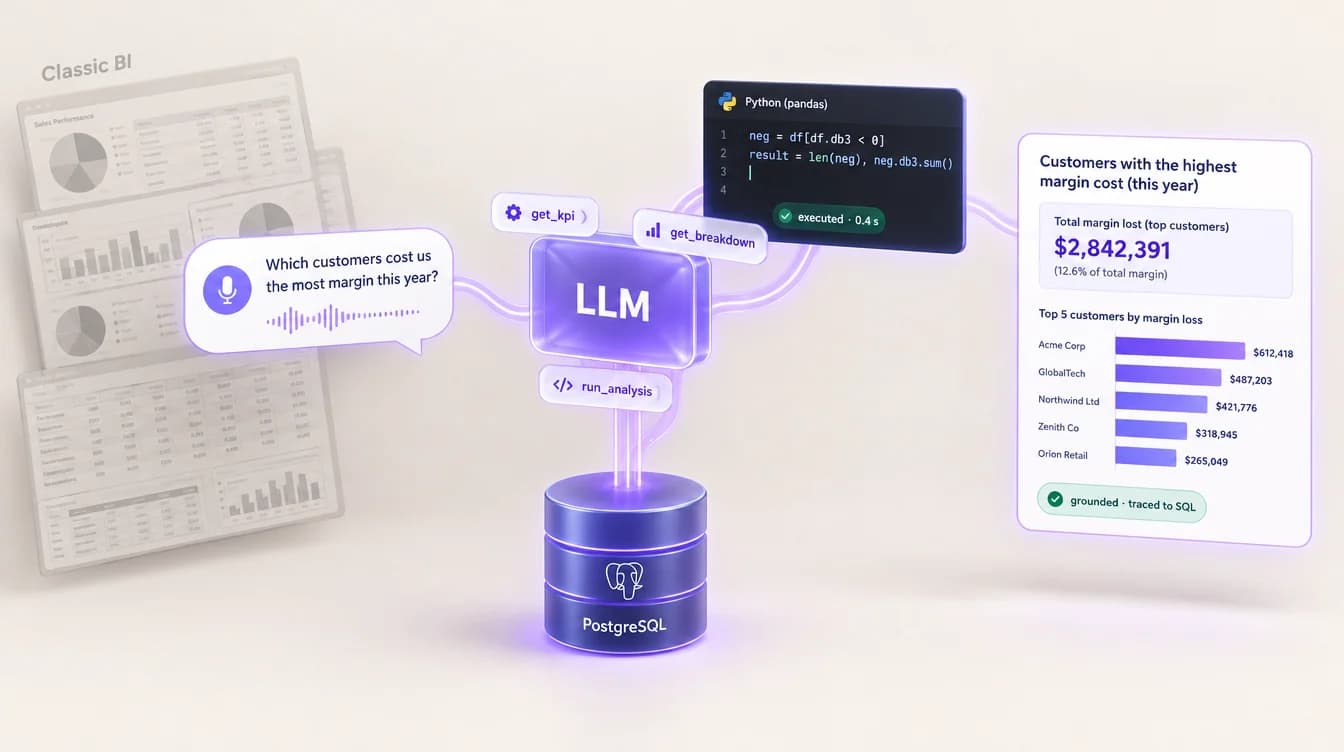
Ask the data
- 1Ask a business question in plain language
- 2The agent picks tools from the metric registry
- 3Scoped queries run on the canonical marts
- 4Population maths runs as code in the sandbox
- 5Answer arrives with figures, actions and a full tool trace
Steer the sales force
- 1An agent logs in and sees only their own book
- 2Margin leaks are broken down per customer
- 3Each leak is paired with the lever the agent controls
- 4The assistant answers follow-up questions in the same scope
07b
AI capabilities
Tool-grounded answers
The model can only state figures that came back from read-only tools over the reconciled data layer; when a tool returns nothing, it says so.
Real-time analysis code
When a question needs a count or cumulative share over thousands of rows, the model writes pandas code that is executed, rather than tallying in context.
Inherited security scope
Tools route through the same scoped path as the screens, so a sales agent's assistant can never see another agent's figures.
Tested with a tie-out harness
Answers are re-run against the API and the database: the tool trace must match, and every figure in the prose must appear in the trace.
08
Engineering challenges
- 01
Numbers that disagreed
The root bug was a filter that dropped credit-note lines, inflating revenue by 22 % and margin by 34 %. The rule now lives in exactly one view, and a test asserts every mart agrees to 0.000 % drift.
- 02
LLMs cannot count
Given all rows, the model answered a population count with 49, 68 and 99 across runs. Executing model-written code instead made it exact, without the sandbox ever touching the database.
- 03
Executing model-written code safely
Import allowlists alone are not enough, because pandas itself can do IO. An AST gate also blocks the IO and eval methods, dunder traversal and getattr bypasses; ten escape attempts are part of the test suite.
- 04
Row-level security that cannot leak
An empty scope means no rows, never no filter, and scoped queries are rerouted to the line-level fact when a mart has no agent column.
09
Technical differentiators
A question, not a dashboard
Managers ask what they want to know in their own words and get a decision-shaped answer with figures and the levers behind them.
Proven, not plausible
KPIs reconcile to the official ERP export within 0.44 %. On ten hard benchmark questions the assistant was exact on eight and refused the unanswerable ones; the two counting misses became exact once it could run code.
Fast where it counts
Like-for-like queries dropped from 3.85 s to 0.13 s, and a 105.7 MB map file was simplified to 0.64 MB with every region kept.
10
Explore further
The source repository is private. A live walkthrough is available on request.